When I was in Sierra Leone I made a commitment that I would do an 'in memoriam' page on this blog for all the women who died on our ward (or occasionally having just left it) while I was in Makeni Government Hospital. These women were all poor, rural Africans. I hope by publishing this they will lodge in your heart and not be forgotten by the outside world.
2009
Babylove Kargbo aged 18 died 20 October from postpartum haemorrhage
Isatu Kanu aged 17 died 21 October from eclampsia
Kadiatu Kamora aged 22 died 22 October from a ruptured uterus
Saffiatu Sesay aged 24 died 26 October from eclampsia
Finah Marrah aged 35 died 27 October from 'prolonged labour'
Saffie Bangura aged 22 died 15 November with retained 2nd twin
Kadiatu Kamara aged 23 died 21 November from hepatitis
Finah Adamo aged 25 died 20 December from anaemia
Harba Conteh aged 32 died 26 December from eclampsia
Fatmata Bangura aged 17 died December 29 from eclampsia
2010
M'balu Koroma no age given died 24 January from antepartum haemorrhage
Fatmata Mansary age 17 died 26 January from obstructed labour
Nancy Conteh aged 35 died 8 February from postpartum haemorrhage
Thursday, 16 September 2010

Friday, 20 August 2010
Back home
My dear readers
The observant amongst you will have noticed that I have not written a blog for some time. In fact, the last one was April 1st and it is now August 20th. This is because I returned home to the UK unexpectedly on May 10th and this blog has not been uppermost in my mind. Only now am I getting round to saying farewell to you all.
I do miss Sierra Leone and, forgive the cliche, it was a life-changing experience. To have been able to uproot myself and live in relatively basic conditions was a real eye-opener and I am amazed at how I adapted to it. It did take me about 3 months to do so but then it all became my life and it was just normal.
The things I found difficult were: living in fear that the water would run out, not being in easy contact with friends and family back home, finding food that I wanted to eat, the heat which was pretty relentless and I was constantly wet, travelling and I expect there were other things once upon a time but I seem now to have forgotten them.
But then there were the extraordinary things. I always felt part of a group of supportive friends and if any of them read this, it was great to know you all. I have written elsewhere about the starry sky which is a thing we hardly ever see in the UK (or not my bits of it, anyway). It was fascinating to see how the local people took their pleasure and fun where they could and usually in ways that we westerners would scorn. They dance at any opportunity - if there is any music anywhere such as in a shop, then they will dance. And no-one looks at them and thinks 'nutter' like they would here and move away. No, it was quite normal and acceptable. Most ordinary people have no access to television. On some evenings there would be a big crowd around one of the street stalls in Makeni; someone would have a tiny, tiny tv screen and this large crowd would be craning their necks to try to watch it.
One of the things I miss most is the morning hymn singing in the midwifery school. I would wait in the library for the students to finish their prayers and would hear, drifting through the corridors, the inimitable sound of African women singing with passion.
I will be uploading photos over the next few weeks, so please keep an eye on my blog still.
Africa, I miss you.
The observant amongst you will have noticed that I have not written a blog for some time. In fact, the last one was April 1st and it is now August 20th. This is because I returned home to the UK unexpectedly on May 10th and this blog has not been uppermost in my mind. Only now am I getting round to saying farewell to you all.
I do miss Sierra Leone and, forgive the cliche, it was a life-changing experience. To have been able to uproot myself and live in relatively basic conditions was a real eye-opener and I am amazed at how I adapted to it. It did take me about 3 months to do so but then it all became my life and it was just normal.
The things I found difficult were: living in fear that the water would run out, not being in easy contact with friends and family back home, finding food that I wanted to eat, the heat which was pretty relentless and I was constantly wet, travelling and I expect there were other things once upon a time but I seem now to have forgotten them.
But then there were the extraordinary things. I always felt part of a group of supportive friends and if any of them read this, it was great to know you all. I have written elsewhere about the starry sky which is a thing we hardly ever see in the UK (or not my bits of it, anyway). It was fascinating to see how the local people took their pleasure and fun where they could and usually in ways that we westerners would scorn. They dance at any opportunity - if there is any music anywhere such as in a shop, then they will dance. And no-one looks at them and thinks 'nutter' like they would here and move away. No, it was quite normal and acceptable. Most ordinary people have no access to television. On some evenings there would be a big crowd around one of the street stalls in Makeni; someone would have a tiny, tiny tv screen and this large crowd would be craning their necks to try to watch it.
One of the things I miss most is the morning hymn singing in the midwifery school. I would wait in the library for the students to finish their prayers and would hear, drifting through the corridors, the inimitable sound of African women singing with passion.
I will be uploading photos over the next few weeks, so please keep an eye on my blog still.
Africa, I miss you.
Saturday, 3 April 2010
Children
I seem to live in a sea of children; in our neighbourhood there seem to be loads of them all over the place and usually calling 'oporto' (white person) after me. It gets very tiresome - see blog about political correctness - and whenever I open the front gate they come rushing over in whatever state of dress/undress and ask for 'dirty'. This means the waste, rubbish, trash, garbage or whatever you want to call it: I pay them to take it away. I have no idea how I would get rid of it if they didn't take it. They are always very keen to earn money, of course, so it matters not one bit if I gave one of them 3 bags of 'dirty' 10 minutes ago, they will still come running asking for it as though I make an endless supply of rubbish. I have no idea what they do with the stuff I give them and, quite honestly, I don't want to know. They are all poor and live in very basic housing into which I have never ventured. Quite a lot of them have malnutrition as evinced by the gingery tinge to their hair and they are often completely naked but not always. One girl this afternoon was dressed up an a princess outfit. There are an awful lot of umbilical hernias here and I would like to know why. I have heard theories about low protein diets causing weak abdominal muscles and various other things, none of which is overly convincing I think. They show great ingenuity in creating toys for themselves: you see boys dragging along a tin can on a string, pretending it's a car and they make kites out of black bin liners attached to a piece of string. Also they do that thing I have only seen in Victorian children's books; they have an old wheel or tyre and run down the road pushing it along with a stick. I'm not sure I have explained that very well and it must have a name - hoop and stick maybe? - I know I never did it. They love playing football and usually have rubbish balls to do it with. When I was walking here this evening a boy was calling after me 'give me a ball' time and time again (please not being a word in their vocabulary) as though I had lots of them stashed about my person. In addition to asking for balls they ask outright for money and food -'oporto emadi' or 'white person feed me'. If they see you with anything, they want it. If you are drinking water from a bottle they will come up and ask for it, if you buy something at a roadside stall they stand beside you and expect to be given what you buy, or at the very least given the change. These are not children of famine or war. Quite a few of them look at me and burst into tears; they are frightened of white people as their families tell them if they don't behave a white person will come and take them/eat them/what you will. It's always good to be cast in the role of the villain. The organisation I am with tells us not to do anything to promote or condone child labour but the reality is that after school many of them walk around with a tray on their head, selling stuff and if we didn't buy from them their lives would be worse, not better. So that's the kids done and dusted.
Tuesday, 2 March 2010
Animals
When I first got here I thought everything would try to kill me. I no longer think that. But I know some things wouldn't mind trying.
I shall start with the small beasts: ants. We have lots and lots of teeny, tiny little ants that want to be in our food and everywhere else. They don't bite. They are so weeny you can hardly see them but you feel them running over your arms and hands and it feels like a little tickle. Then you look: no, it's ants. So you squash them. We do have house flies but not that many really, well not considering the general lack of hygiene. There are some particularly nasty bee-type things which have such a narrow waist as to look almost in two separate halves and some have been making a nest out on my back porch ever since I have been here. But they are Sierra Leonean and are working slowly. I asked our cleaner Mohammed how I could get rid of them. He said to go out to the porch at midnight with a can of insecticide, leave the back door open, spray the nest and run like hell back into the house. I haven't done it yet; I think they fit into the group of animals that may try to kill me.
Have I told you about our cat Ginger? He keeps the rats down and he does sometimes catch them. I opened the back door a couple of weeks ago to find a fresh kill right where I was about to put my foot. Nice. Most mornings I go on rat patrol to scoop up any bodies and I put them in an empty milk tin, pour petrol over them and set it alight. But I have never managed to burn the whole body and rat tails seem particularly resistant... Ginger likes to play with lizards and I found a dead one yesterday which he then proceeded to eat. And five minutes later sicked up. I think they taste bad as he always drinks water after playing with them. He caught a bat and eviscerated it a couple of weeks back, quite neatly, I must say. Later I saw him being a bit odd so kept my eye on him for a while in case he had rabies but he seems ok.
Oooh! Snakes! I have seen 3 so far I think and 2 were dead. 2 of them were black mambas which had been found in the fields near the house and had been decapitated by some brave soul. The other one was a really bright green one crossing the road one Saturday morning (probably out shopping or something) and we drove right over it. Someone said you should never drive over a snake as it can get up into the engine and into the vehicle, but I really don't think this one could have survived a 4 wheel drive truck going over it at right angles. Besides, should you brake for a snake?
What else to tell you about? Chickens are absolutely everywhere. Sometimes young ones come under our garage gate and Ginger 'plays' with them; I haven't seen him hurt one yet but they sqwak a lot and then I have to chase them around the perimeter of the house with a towel to throw over them and put them back outside. Chickens strut around all over the hospital and no taxi ride is complete without one in a plastic bag. Talking of the hospital, I have seen in the grounds (beside the chickens, of course) a goat tethered to a post, a cow tethered to the same post after the goat had gone, lots of dogs just lying around and the odd cat. And spiders. My sometime housemate Kiki works part-time in a hospital about a half hour drive from Makeni. One day she and the hospital administrator came to Makeni to do some shopping in the ambulance (yes, that is what they are for) and, while up near our lorry park, he saw his goat that had been stolen the previous night so he put it in the ambulance and took it home. Would that ever happen in England? We do have lots of mosquitos, but it is not their breeding season at the moment so they are not causing too much trouble to me now.
DOGS. I do not trust the dogs here at all; they are generally very lazy and in bad condition but I don't like being barked at by them as I think they will attack me and give me rabies. You will see I am very concerned about rabies. When I was out in a car late one night just after I got here there were great packs of dogs just roaming the streets; I would shoot them all. Someone told me they are guard dogs but they don't seem to do much guarding to me.
You will note that I am generally very unsentimental about animals and am even more so here.
I am told they eat cats, but I draw the line at that.
I shall start with the small beasts: ants. We have lots and lots of teeny, tiny little ants that want to be in our food and everywhere else. They don't bite. They are so weeny you can hardly see them but you feel them running over your arms and hands and it feels like a little tickle. Then you look: no, it's ants. So you squash them. We do have house flies but not that many really, well not considering the general lack of hygiene. There are some particularly nasty bee-type things which have such a narrow waist as to look almost in two separate halves and some have been making a nest out on my back porch ever since I have been here. But they are Sierra Leonean and are working slowly. I asked our cleaner Mohammed how I could get rid of them. He said to go out to the porch at midnight with a can of insecticide, leave the back door open, spray the nest and run like hell back into the house. I haven't done it yet; I think they fit into the group of animals that may try to kill me.
Have I told you about our cat Ginger? He keeps the rats down and he does sometimes catch them. I opened the back door a couple of weeks ago to find a fresh kill right where I was about to put my foot. Nice. Most mornings I go on rat patrol to scoop up any bodies and I put them in an empty milk tin, pour petrol over them and set it alight. But I have never managed to burn the whole body and rat tails seem particularly resistant... Ginger likes to play with lizards and I found a dead one yesterday which he then proceeded to eat. And five minutes later sicked up. I think they taste bad as he always drinks water after playing with them. He caught a bat and eviscerated it a couple of weeks back, quite neatly, I must say. Later I saw him being a bit odd so kept my eye on him for a while in case he had rabies but he seems ok.
Oooh! Snakes! I have seen 3 so far I think and 2 were dead. 2 of them were black mambas which had been found in the fields near the house and had been decapitated by some brave soul. The other one was a really bright green one crossing the road one Saturday morning (probably out shopping or something) and we drove right over it. Someone said you should never drive over a snake as it can get up into the engine and into the vehicle, but I really don't think this one could have survived a 4 wheel drive truck going over it at right angles. Besides, should you brake for a snake?
What else to tell you about? Chickens are absolutely everywhere. Sometimes young ones come under our garage gate and Ginger 'plays' with them; I haven't seen him hurt one yet but they sqwak a lot and then I have to chase them around the perimeter of the house with a towel to throw over them and put them back outside. Chickens strut around all over the hospital and no taxi ride is complete without one in a plastic bag. Talking of the hospital, I have seen in the grounds (beside the chickens, of course) a goat tethered to a post, a cow tethered to the same post after the goat had gone, lots of dogs just lying around and the odd cat. And spiders. My sometime housemate Kiki works part-time in a hospital about a half hour drive from Makeni. One day she and the hospital administrator came to Makeni to do some shopping in the ambulance (yes, that is what they are for) and, while up near our lorry park, he saw his goat that had been stolen the previous night so he put it in the ambulance and took it home. Would that ever happen in England? We do have lots of mosquitos, but it is not their breeding season at the moment so they are not causing too much trouble to me now.
DOGS. I do not trust the dogs here at all; they are generally very lazy and in bad condition but I don't like being barked at by them as I think they will attack me and give me rabies. You will see I am very concerned about rabies. When I was out in a car late one night just after I got here there were great packs of dogs just roaming the streets; I would shoot them all. Someone told me they are guard dogs but they don't seem to do much guarding to me.
You will note that I am generally very unsentimental about animals and am even more so here.
I am told they eat cats, but I draw the line at that.
Monday, 22 February 2010
The New Midwifery School in Makeni
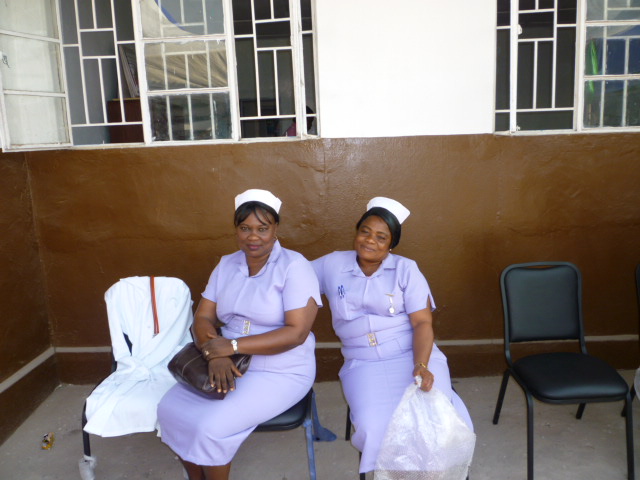

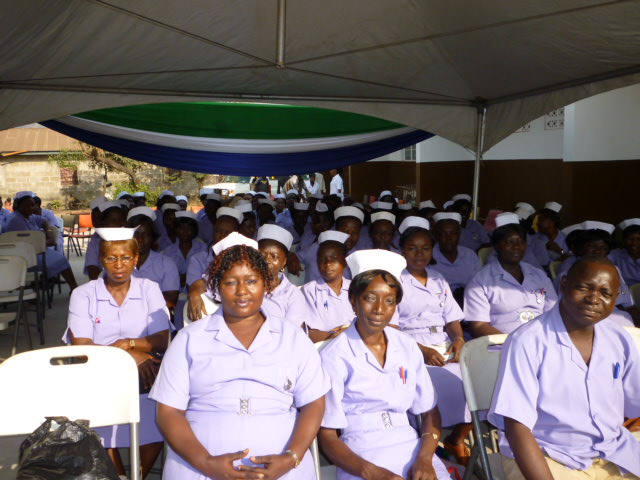
I think I did briefly mention the midwifery school that opened here last month and that brevity does not do it justice as it's been a really big thing. There is only one other training school for midwives in SL and that is in Freetown over 100 miles away. It is very difficult to get any qualified staff to stay anywhere outside of Freetown; they all flock there and consequently there are hardly any qualified health workers in the provinces/regions and still fewer in the remoter parts. I think there are only 95 qualified midwives in this whole country (pop. around 6 million with a high birth rate and, as you may know, the worst maternal and infant mortality rates in the world); our school is currently training 75 and we have another intake in July. Lots of them have problems finding accommodation here, as they come from all over the country, and we have not built our student hostel yet. They are bonded to work in the outlying districts for 2 years after qualifying, where they will find themselves probably the most educated and highly qualified person around for miles. They will be expected to deal with all sorts of problems with very little support. Maybe a mobile phone. They have my utter admiration for being prepared to do that. I have added some photos of the students on the day of the opening.
The school itself is a new building and quite extensive. It sits fairly high up in Makeni, so we get some breeze, and is next door to a hospital; I think it was built on the site of an old hospital. We have a wonderful skills lab. which is much better than anything I had when I was training, and computers and a library. Most of the funding has come from the Netherlands. We do need more textbooks, so if anyone can help get us some, please get in touch. We have only one copy of a standard midwifery textbook for all of our students and tutors. I have been teaching anatomy and physiology and also computer studies. This latter will make my children laugh, but as most of the students had never sat in front of a computer before, I have managed to teach them some useful things. Like how to switch it on and off.
We had the official opening a couple of weeks after the students started. The students were all there in their mauve uniforms (which they have to wear in class too) and I was very proud of them. They did what they called a 'skit' which was a mini play about a labouring woman in the bush going to a traditonal birth attendent (TBA), who referred her to the health post, who referred her to the hospital where the staff all ignored her, but too late anyway; she bled to death. There was supposed to be a countering positive story about going to hospital in good time, but time was, unfortunately, not on the students' side so it was jettisoned. One of the students was sitting near me throughout the proceedings with a bottle of whisky and a bottle of water on a tray on her lap. They were heating up nicely in the boiling sun and I wondered who would be suffering them later. I saw something on the programme called 'libation'; the Paramount Chief and someone else poured of these liquids over the front step. I suppose it was the equivalent of breaking a bottle of champagne over the door. The President's wife, who cut the ribbon, and the Vice President's wife came as well as the Paramount Chief, so it was very high-profile. I took a photo of the PC in all his finery, which I would love to show you and him (as he wanted a copy) but can't manage it. Probably best to try to stay on good terms with him as far as I can, though.... We also had some traditional drummers in costume, who kept starting too early with the drumming, such was their enthusiasm but finally they were allowed to do their stuff around libation time. And we got to eat, too, so a good time was had by all. Then the hard work started.
People often, very kindly I think, tell me my blogs are funny and make them laugh. This one is not one of those, as the work ones cannot be either. This school is so badly needed, the midwives are so badly needed too and it is possible to turn their appalling mortality stats around. We have a British booklet in our library which describes how this was done over a 6 year period in a Lancashire town which had the worst maternal mortality rates in the UK in the 1920s and early 1930s. Over that relatively short period they reduced it by about two thirds by using every opportunity for education about the importance of ante natal care and looking critically at their own practices. We have 4 male students; one of them told me that he decided to do this course after his sister died last June, giving birth to her twins, who also died.
So next time, maybe a bit lighter ...
Tuesday, 2 February 2010
Communication
What aspect shall I take first? Phones: as may know, there are no landlines in this country. We do have telegraph poles but no lines between them as they were cut down during the rebel war (ended 2002). So we rely on mobile phones and thank heaven for them. But coverage is patchy so people often have up to 4 handsets on the different networks and, as far as I can work out, they only have pay as you go, not contracts. Well, that would make no sense because there is no postal service (see below) so they couldn't send out bills and I suspect the banking system is not very sophisticated so direct debits and suchlike may be unknown for all I know. Anyway, most people don't have a bank account. Most people have no money. I am on Zain network as I was given their sim by my organisation when I arrived here. I phoned my daughter last week as it was her birthday and I ran out of credit. When I tried to buy more, there was none! Nowhere in this town could you buy Zain credit for several days. So I was incomunicado for almost a week. Don't forget: no landlines.
Internet: we do have modem sticks (or dongles perhaps you call them) but they are very expensive and I discovered they do not work with the operating system I have on my laptop (Linux). There are only 2 places I know of where they have internet facilities - I am sitting in one of them now - and sometimes the server is down. One of them - the other one - is a bike ride away, so you pay for a taxi up there, discover you can't use the internet and have to have a taxi back again. This can happen time after time. Why not phone them first? Because there is no phone! There are also a few dodgy looking places that say 'internet cafe' (believe me, 'cafe' would not come into it) but they usually have unbelievably loud football on and somehow I don't think a respectable lady would want to be seen in them.
Postal service: none. We do have a post office, a lovely old colonial type building and they do have a post office box system, which I may investigate, as it would be better to send post there instead of via my organisation. But I would have to go to collect anything, rather like if the postman in the UK can't deliver your parcel and you have to go and get it. But if you don't know something is coming for you (uncertain phones and email access, don't forget) you would leave things there for ever. I got 3 letters early this month, unfortunately from Revenue and Customs, which had been posted in November, and one Christmas card was hand delivered by my organisation when they visited on the final Saturday in January. It was postmarked 2nd December. Yes, I know that happens at home, too.
I will include photos here as they are a form of communication and I had hoped very much to post some on this blog. I still have hopes, in fact, but they are fading. Most internet access is very slow and the only time I have managed to upload any photos it took quite a long time and I regretted not choosing the pictures a bit more carefully. I had imagined I could upload lots of them and could not. When I tried with the modem stick on a friend's laptop, we aborted mission after 40 minutes trying to upload 2 pictures. Also, they do not believe in viruses here, or they have no virus protection anyway. So I am worried if I put my memory card from my camera into one of their computers it will stuff up my lovely digital camera. So those are my excuses.
Internet: we do have modem sticks (or dongles perhaps you call them) but they are very expensive and I discovered they do not work with the operating system I have on my laptop (Linux). There are only 2 places I know of where they have internet facilities - I am sitting in one of them now - and sometimes the server is down. One of them - the other one - is a bike ride away, so you pay for a taxi up there, discover you can't use the internet and have to have a taxi back again. This can happen time after time. Why not phone them first? Because there is no phone! There are also a few dodgy looking places that say 'internet cafe' (believe me, 'cafe' would not come into it) but they usually have unbelievably loud football on and somehow I don't think a respectable lady would want to be seen in them.
Postal service: none. We do have a post office, a lovely old colonial type building and they do have a post office box system, which I may investigate, as it would be better to send post there instead of via my organisation. But I would have to go to collect anything, rather like if the postman in the UK can't deliver your parcel and you have to go and get it. But if you don't know something is coming for you (uncertain phones and email access, don't forget) you would leave things there for ever. I got 3 letters early this month, unfortunately from Revenue and Customs, which had been posted in November, and one Christmas card was hand delivered by my organisation when they visited on the final Saturday in January. It was postmarked 2nd December. Yes, I know that happens at home, too.
I will include photos here as they are a form of communication and I had hoped very much to post some on this blog. I still have hopes, in fact, but they are fading. Most internet access is very slow and the only time I have managed to upload any photos it took quite a long time and I regretted not choosing the pictures a bit more carefully. I had imagined I could upload lots of them and could not. When I tried with the modem stick on a friend's laptop, we aborted mission after 40 minutes trying to upload 2 pictures. Also, they do not believe in viruses here, or they have no virus protection anyway. So I am worried if I put my memory card from my camera into one of their computers it will stuff up my lovely digital camera. So those are my excuses.
Friday, 29 January 2010
Work 2
So back to work. I have not written about that for some time so it's about time I picked it up again.
Do I have a typical day at work? Probably not, but I will try to describe one.
I get up about 7 and walk to work, about 10 minutes away, past the local people washing at the public tap and the (semi) naked children, past the fish market and into the main road where I dodge the traffic and all the kids shouting "oporto" (white person) at me. I sometimes give them a regal wave. When I get to work I am usually very hot and sit in the office for about 15 minutes drinking water. We buy packets of it; there is no safe drinking water in the hospital. There is not really any water at all. I therefore want to avoid using the loo there. Then I steel myself and go to the maternity ward where I do a bed round and make notes about the patients. Some of the staff - or most of them - have no idea why I want to write notes about the patients and cannot understand why I find it helpful to know about the patients. Hmm. We have only had one maternal death this month; she had an antepartum haemorrhage, they wanted 3 units of blood to transfuse but they could only get one and she bled again and so died. They get the blood from relatives. We have now got a system for notifying maternal deaths and this is just starting up now. The 2005 figures were 2100:100,000 maternities against a UK figure of 9:100,000. I have been trying to organise the maternity ward but to no avail. I tried to get them doing a proper handover and write notes about the patients but it did not work out. Literacy is a problem here and I found they were unable to pick out the relevant details, so that foundered. I tried to get a system of named staff caring for named patients, which seems so obvious to me, but this proved impossible. I have also tried to instigate daily baby checks, again this has not worked out. The babies do not get checked over when they are born nor on a daily basis, as they would at home. I tried this back in November and it failed then. Someone said that they don't bother about babies here because so many die before they are 5 but maybe, just maybe, some of them would survive if anyone did bother about them. Silly idea of mine. Most of our babies are at the lower end of the normal birthweight range, most likely because of maternal anaemia. This is due to malnutrition and/or malaria. Less than 2.5kg is low birthweight and we have lots about 2.6 or so and we have had some about 1.7kg. Needless to say there is no neonatal care unit. How could there be? No electricity! So, after a while of reading about the drugs and care not given, I go back to the office and write stuff.
In order to feel I am achieving something, I have started some teaching sessions for anyone who is interested. This is actually what I am supposed to be doing: it is called 'capacity building'. They are about maternity/midwifery but open to anyone as the staff rotate around the hospital in 6 month batches. So twice on Mondays I hope some people will show up and they have so far. I did last Monday's session on pre-eclampsia and eclampsia and had 8 to the first session at 11am and 5 to the 3pm show, so not too bad. Only 2 from maternity though. Next Monday's sessions willl be on antepartum haemorrhage. Apt, I think.
The other things is that the new Midwifery school opened here a couple of weeks ago with a lot of razzmatazz. I am also working there, teaching anatomy and physiology which is great because I have to learn it before I can teach it! I did learn it once for exams but really have forgotten so much, but the best way to learn something is by teaching it. We have electricity and ceiling fans and a staff room with a fridge and a skills lab with lots of models and teaching aids ... Can you guess where I would rather work? They do have big classes here and I have 73 in one class. I had thought it would be more daunting than it actually is standing up in front of that lot, but I a manage. They are all nurses who are on a 2 year midwifery course and they have lots of experience already. They all recognise me when I am out, of course, as we white people stick out like sore thumbs, and so I am forever pretending I know who they are when I don't. I think they probably know that.
I seldom work more than a 6 hour day, which is the norm here. 8 hour days are called 'white people's hours', but it is very hot here, don't forget. I walk home from the hospital and get an ocada (motorbike taxi) back from the school. And then I have a very exciting evening in the bar with whatever other expats turn up! We get our cat Ginger some meat or fish on the way home, grab an ocada and go home and are often in bed about 10. How's that for an exciting life?
Do I have a typical day at work? Probably not, but I will try to describe one.
I get up about 7 and walk to work, about 10 minutes away, past the local people washing at the public tap and the (semi) naked children, past the fish market and into the main road where I dodge the traffic and all the kids shouting "oporto" (white person) at me. I sometimes give them a regal wave. When I get to work I am usually very hot and sit in the office for about 15 minutes drinking water. We buy packets of it; there is no safe drinking water in the hospital. There is not really any water at all. I therefore want to avoid using the loo there. Then I steel myself and go to the maternity ward where I do a bed round and make notes about the patients. Some of the staff - or most of them - have no idea why I want to write notes about the patients and cannot understand why I find it helpful to know about the patients. Hmm. We have only had one maternal death this month; she had an antepartum haemorrhage, they wanted 3 units of blood to transfuse but they could only get one and she bled again and so died. They get the blood from relatives. We have now got a system for notifying maternal deaths and this is just starting up now. The 2005 figures were 2100:100,000 maternities against a UK figure of 9:100,000. I have been trying to organise the maternity ward but to no avail. I tried to get them doing a proper handover and write notes about the patients but it did not work out. Literacy is a problem here and I found they were unable to pick out the relevant details, so that foundered. I tried to get a system of named staff caring for named patients, which seems so obvious to me, but this proved impossible. I have also tried to instigate daily baby checks, again this has not worked out. The babies do not get checked over when they are born nor on a daily basis, as they would at home. I tried this back in November and it failed then. Someone said that they don't bother about babies here because so many die before they are 5 but maybe, just maybe, some of them would survive if anyone did bother about them. Silly idea of mine. Most of our babies are at the lower end of the normal birthweight range, most likely because of maternal anaemia. This is due to malnutrition and/or malaria. Less than 2.5kg is low birthweight and we have lots about 2.6 or so and we have had some about 1.7kg. Needless to say there is no neonatal care unit. How could there be? No electricity! So, after a while of reading about the drugs and care not given, I go back to the office and write stuff.
In order to feel I am achieving something, I have started some teaching sessions for anyone who is interested. This is actually what I am supposed to be doing: it is called 'capacity building'. They are about maternity/midwifery but open to anyone as the staff rotate around the hospital in 6 month batches. So twice on Mondays I hope some people will show up and they have so far. I did last Monday's session on pre-eclampsia and eclampsia and had 8 to the first session at 11am and 5 to the 3pm show, so not too bad. Only 2 from maternity though. Next Monday's sessions willl be on antepartum haemorrhage. Apt, I think.
The other things is that the new Midwifery school opened here a couple of weeks ago with a lot of razzmatazz. I am also working there, teaching anatomy and physiology which is great because I have to learn it before I can teach it! I did learn it once for exams but really have forgotten so much, but the best way to learn something is by teaching it. We have electricity and ceiling fans and a staff room with a fridge and a skills lab with lots of models and teaching aids ... Can you guess where I would rather work? They do have big classes here and I have 73 in one class. I had thought it would be more daunting than it actually is standing up in front of that lot, but I a manage. They are all nurses who are on a 2 year midwifery course and they have lots of experience already. They all recognise me when I am out, of course, as we white people stick out like sore thumbs, and so I am forever pretending I know who they are when I don't. I think they probably know that.
I seldom work more than a 6 hour day, which is the norm here. 8 hour days are called 'white people's hours', but it is very hot here, don't forget. I walk home from the hospital and get an ocada (motorbike taxi) back from the school. And then I have a very exciting evening in the bar with whatever other expats turn up! We get our cat Ginger some meat or fish on the way home, grab an ocada and go home and are often in bed about 10. How's that for an exciting life?
Saturday, 23 January 2010
NOISE
OHMYGODITISSONOISYHERE!
I will stop shouting now. There is a bit of a lull in the noise level. Before I came I had an idea that it would be peaceful over here, I would be bathed in lovely bird song and the sound of the wind rustling through the trees. Fat chance. I have never heard such a racket in my life!
I will tell you about a typical 24 hour cycle. The quietest bit is usually from about 2 to 5.30am and that is not guaranteed. Around 5.30 the call to prayer is broadcast from the main mosque, then a smaller mosque joins in and, not to be outdone, the churches' bells start ringing. The call to prayer goes on for about half an hour. Why can't they get an alarm clock instead? Then our neighbours start their morning chores while it is still cool; lighting fires, chopping wood (maybe not in that order) and calling to each other. Whispering is unknown. Then everyone is up and about. The children cry and people argue and sometimes there is music, too. So I walk to work and along the road am passed by countless noisy vehicles with non-functioning exhausts, cranky engines and I don't know what. The local mobile phone companies like to drive trucks through the town playing music at a volume only possible in Africa, I suspect, aided and abetted by the generator to power it. All speakers must be at least the size of a wardrobe. I believe this may be enshrined in law here. The hospital is for sick people but they don't need peace and quiet, no no. They would probably think they had died and gone to hell. So the noise level continues unabated and in the evening there are the televised football matches (usually Manchester Utd. against whoever). There is a house near us where you can go to watch them and I am told you can't get a sheet of paper between the men crammed in there watching. I don't need to tell you that I can sit in my house and listen to the dulcet tones of whoever the English commentators are, do I? Then the music starts - always distorted - don't forget the size of the speakers, and sometimes they seem to have competitions to see who can play it the loudest. The time of day matters not one jot. You want to play it full volume at 4 or 7 am? Fine. As the electricity is provided by generator we have that added to the mix and, of course, we contribute to that ourselves as we like some light in the evenings. We also need it to pump the water from the well to the tank. We normally turn it off around 10 pm. So sometimes it gets quietish around midnight but then the dogs start!
IF YOU COME TO SIERRA LEONE BRING EARPLUGS.
I will stop shouting now. There is a bit of a lull in the noise level. Before I came I had an idea that it would be peaceful over here, I would be bathed in lovely bird song and the sound of the wind rustling through the trees. Fat chance. I have never heard such a racket in my life!
I will tell you about a typical 24 hour cycle. The quietest bit is usually from about 2 to 5.30am and that is not guaranteed. Around 5.30 the call to prayer is broadcast from the main mosque, then a smaller mosque joins in and, not to be outdone, the churches' bells start ringing. The call to prayer goes on for about half an hour. Why can't they get an alarm clock instead? Then our neighbours start their morning chores while it is still cool; lighting fires, chopping wood (maybe not in that order) and calling to each other. Whispering is unknown. Then everyone is up and about. The children cry and people argue and sometimes there is music, too. So I walk to work and along the road am passed by countless noisy vehicles with non-functioning exhausts, cranky engines and I don't know what. The local mobile phone companies like to drive trucks through the town playing music at a volume only possible in Africa, I suspect, aided and abetted by the generator to power it. All speakers must be at least the size of a wardrobe. I believe this may be enshrined in law here. The hospital is for sick people but they don't need peace and quiet, no no. They would probably think they had died and gone to hell. So the noise level continues unabated and in the evening there are the televised football matches (usually Manchester Utd. against whoever). There is a house near us where you can go to watch them and I am told you can't get a sheet of paper between the men crammed in there watching. I don't need to tell you that I can sit in my house and listen to the dulcet tones of whoever the English commentators are, do I? Then the music starts - always distorted - don't forget the size of the speakers, and sometimes they seem to have competitions to see who can play it the loudest. The time of day matters not one jot. You want to play it full volume at 4 or 7 am? Fine. As the electricity is provided by generator we have that added to the mix and, of course, we contribute to that ourselves as we like some light in the evenings. We also need it to pump the water from the well to the tank. We normally turn it off around 10 pm. So sometimes it gets quietish around midnight but then the dogs start!
IF YOU COME TO SIERRA LEONE BRING EARPLUGS.
Tuesday, 5 January 2010
Christmas


Was it really Christmas? I don't think so as it was far too hot and my Christmases so far have been dull and rainy. But that is in England and I'm in Sierra Leone, so it makes sense. It just felt so odd. We had none of the relentless pre-Christmas commercialism that you get back home. I did not see a single Christmas card or wrapping paper or anything at all. I got one Christmas card from a fellow Brit who had been back home and come back with cards and crackers. I saw 3 Christmas trees; one outside the Lebanese supermarket in Bo, one at Magbenthe hospital and one here in the Wusum hotel, whose internet cafe I am using at the moment.
I went on Christmas eve to the beach at a place called River no. 2 (imaginative, no?) not far from Freetown. The photos above are of River no. 2 and I have just added them (May 2010). I got myself and my rucksack to Magbenthe hospital on a motor bike taxi before 8 in the morning but we didn't leave until about 11. I do like to be punctual! I went with Matt, who is currently taking care of the farm his father manages about 40 mins. outside Makeni, Natasha, a Dutch midwife from Magbenthe hospital and Ellenoor a Dutch physio also from Magbenthe and her boyfriend Desmond. We were a motley crew: a Sierra Leoneon, 2 Dutch, one South African and British me. Matt and Natasha and I were not too keen on the accomodation at River no. 2. If you have the Bradt guide book, it sounds much better than it is and, for $50 per room per night, it is not worth it. However, the location is great and the food was not bad. We spent the night of Christmas Eve on the beach with a bottle of wine, a bonfire and looking up at the stars. I am sure we saw a Christmas tree up there ...
On Christmas day we went the few miles over the usual cratered road to Franco's where Suzie and Bernhard were staying and I had my lobster on the beach that I had so long wanted at Christmas. Well, almost on the beach; actually on a terrace overlooking the beach. It was a lovely day and we had Suzie's Christmas crackers and wore out paper hats. How British! Boxing day was similar but minus lobster, then back to Makeni on 27th. So that was it; no presents either given or received, no mad last minute Christmas shopping or anything. Just being lazy. And eating lobster.
New Year was quiet and back in Makeni. Nothing much else to say really. I did miss my girls, but as it did not seem like Christmas at all that was bearable.
A Happy new year to you all and I shall be home this year! Before you know it!!
Saturday, 19 December 2009


Political Correctness
Just does not exist here. They would not recogise it if it bit them in the bottom. Every time we leave the house we get 'oporto' yelled at us, mainly by children but sometimes by adults as in 'oporto, come over here!' Oporto means white person. Lots of us find it very wearing after a while.
Itry to hear it as my name or as hello, but it does not always work. why has my type gone funny? Sorry. Can you imagine what would happen if we yelled ’black man’ all the time in London?
They can’t tell us apart at all as we all look the same to them, as they will very cheerfully tell you. They sometimes call the Filipinos ’ching chong’, thinking they are Chinese. My housemate Annette is Filipina and people think she is my daughter.
They have a totally different of concept of body image, too. Not long after I arrived a man asked me if I was English and when I asked him how he knew he said it was because we all have fat bodies! He meant it as a compliment as that is what they like. Fat=prosperous. When we went to Tiwai island 2 weeks ago and slept in tents, the man said the fat one (me) should have the biggest tent. Again, a compliment in his terms but not in mine. For anyone who does not know me, I could certainly lose some weight (and am over here) but I am not grossly overweight. I don’t get upset really but it gets irritating.
There is no privacy at all here Life is lived on the steet in public, like a goldfish bowl. It is hot and most of their homes aren’t good, so it’s much better to be outside. Meals are taken outside from a communal plate. They think we are really odd eating inside, behind our compound wall. And maybe we are.
They watch everything we do, which some expats have failed to grasp unfortunately. My housemate Celine (who returned to Canada yesterday) told me when she first came here she went for a drink at a bar and was told the following day exactly what she’d had to drink and who her companions were. Still, the upside is that if you can’t find your friend you just ask anyone ’where my paddy?’ (friend) and they say she just went into the bank.
Who needs CCTV cameras?
Itry to hear it as my name or as hello, but it does not always work. why has my type gone funny? Sorry. Can you imagine what would happen if we yelled ’black man’ all the time in London?
They can’t tell us apart at all as we all look the same to them, as they will very cheerfully tell you. They sometimes call the Filipinos ’ching chong’, thinking they are Chinese. My housemate Annette is Filipina and people think she is my daughter.
They have a totally different of concept of body image, too. Not long after I arrived a man asked me if I was English and when I asked him how he knew he said it was because we all have fat bodies! He meant it as a compliment as that is what they like. Fat=prosperous. When we went to Tiwai island 2 weeks ago and slept in tents, the man said the fat one (me) should have the biggest tent. Again, a compliment in his terms but not in mine. For anyone who does not know me, I could certainly lose some weight (and am over here) but I am not grossly overweight. I don’t get upset really but it gets irritating.
There is no privacy at all here Life is lived on the steet in public, like a goldfish bowl. It is hot and most of their homes aren’t good, so it’s much better to be outside. Meals are taken outside from a communal plate. They think we are really odd eating inside, behind our compound wall. And maybe we are.
They watch everything we do, which some expats have failed to grasp unfortunately. My housemate Celine (who returned to Canada yesterday) told me when she first came here she went for a drink at a bar and was told the following day exactly what she’d had to drink and who her companions were. Still, the upside is that if you can’t find your friend you just ask anyone ’where my paddy?’ (friend) and they say she just went into the bank.
Who needs CCTV cameras?
Saturday, 12 December 2009
Food
Before Food, my apologies for the delay in contacting anyone. Internet access has been a nightmare recently and I won't bother you with the details. I am currently borrowing the modem stick (as a dongle is called here) from some friends who are currently in the UK and I cannot access my email account for some reason, so I hope you all find this.
So to the important subject of food, glorious food. Not so glorious for me here, but I am losing weight. When I first came to Makeni, I could not sort out at all how to find food. There is a very scary market which is really crowded with motorbikes weaving in and out and you go through to a covered bit where the food is. And no motorbikes in there at least. But there was not much there, just sweet potatoes, some onions, a few beans. I did see a butcher but did not dare go near it. How I longed for Borough Market. There are stalls out in the streets where they sell fruit and some vegetables and, of course, food is very seasonal here. But then they do this odd thing of having about 10 little stalls along the road but they all sell the same thing! So if you want oranges and onions you have to walk about half a kilometre in 30 degrees plus heat. But then St. Mary's opened. I did write before that it is like Harrods food hall to us (or was it Fortnum's?) but please don't think of that too literally. It is more like a small Somerfield with some household goods in it. But it was such an improvement. It is relatively expensive and will put some of the small traders out of business but the goods are much better.
Today for breakfast I had oatmeal (porridge to us English) which is made from quick cook oats in a tin. I have not had fresh milk since I came to this country and we have dried milk, so I make some up with hot water and put on the porridge and add some maple syrup. Then I make instant coffee with the rest of the milk. My housemate Celine and I walked to St. Mary's fairly early this morning to get some things as we have friends coming over tomorrow. We got 2 bottles of red wine (quite good) as we cannot chill white: no fridge. We found some sliced processed cheese and got very excited and bought that (yes, really) and they had a plate of small, not brilliant tomatoes in the chiller so we got those too. I bought nice bread outside and when we got home we had bread, cheese and tomatoes. And really enjoyed it. I had only had 2 slivers of tomato in sandwiches since I had been there.
I also bought what they call Irish potatoes, to distinguish them from the more common sweet potatoes and I am having garlic mashed potatoes tonight and I shall start when I have finished writing to you, my dear friends. I have no protein to go with them so I may open a tin of green beans. Oh, yes. I very happily spent almost 3 pounds sterling on a tin of
Ambrosia rice pudding a few weeks ago and am hording it for a rainy day. Also, I have had some fresh pineapple which I bought 2 days ago for about one pound 20 pence, which is the equivalent of 2 days pay for a manual worker.
As I said, we have no fridge and in fact it is more sensible to have a freezer. Then you put the generator on in the evening and the freezer functions as a fridge, as fridges don't like to be on for only 4 or so hours a day. In fact, it is pointless. We cook on a 2 ring hob which is powered by calor gas, and we can now get this from St. Mary's (they do ice cream too). When I got here you had to get calor from Freetown (115 miles away). Some people cook on kerosene which stinks to high heaven and most of the locals cook on open fires. Picturesque but medieval, I think.
Tomorrow our friends will bring some food as they like cooking and have better facilities. We are planning to go and get some haloumi cheese and fry it with garlic (no grill) and make some potato salad. And drink wine!
Did you know you can freeze eggs? I had no idea until the St. Mary's man (Lebanese, like most of the enterprising people here) said that the ones we had been buying in the street were frozen ones imported from Europe. His are fresh farm eggs. Egg boxes are unknown here and you carry them home in a plastic bag. You can imagine the results. I often put them in my crash helmet. I also buy Heinz baked beans (there are strong rumours that St. Mary's will be stocking bacon. I wake up hallucinating that I smell it frying) and I have HP sauce. I have started eating Marmite! I hate it but treat it as medicine. Oh, yes, I got some marmalade today, too.
If you have a vehicle, the common way to shop is to pull up outside the shop (small, open fronted shack really) and yell 'bread!" or whatever you want and they come running over. I think I will try it outside Waitrose when I get home and see what happens.
They have also recently opened a new restaurant, which is the best here. Again, do not get too excited as all things are relative. The service is much better there as the man who owns it spent 5 years in London and understands the concept of customer service, which is generally unknown here. You can go even to the 'posh' hotel (not very), order something very indifferent, wait half an hour only to have them saunter up and tell you they haven't got it.
When I come back home, I am going to eat bacon and eggs and drink fresh milk. I shall eat clotted cream until it comes out of my ears. And no doubt regain any weight I have lost. I had thought I was not particularly interested in food. Oh but I am!
So to the important subject of food, glorious food. Not so glorious for me here, but I am losing weight. When I first came to Makeni, I could not sort out at all how to find food. There is a very scary market which is really crowded with motorbikes weaving in and out and you go through to a covered bit where the food is. And no motorbikes in there at least. But there was not much there, just sweet potatoes, some onions, a few beans. I did see a butcher but did not dare go near it. How I longed for Borough Market. There are stalls out in the streets where they sell fruit and some vegetables and, of course, food is very seasonal here. But then they do this odd thing of having about 10 little stalls along the road but they all sell the same thing! So if you want oranges and onions you have to walk about half a kilometre in 30 degrees plus heat. But then St. Mary's opened. I did write before that it is like Harrods food hall to us (or was it Fortnum's?) but please don't think of that too literally. It is more like a small Somerfield with some household goods in it. But it was such an improvement. It is relatively expensive and will put some of the small traders out of business but the goods are much better.
Today for breakfast I had oatmeal (porridge to us English) which is made from quick cook oats in a tin. I have not had fresh milk since I came to this country and we have dried milk, so I make some up with hot water and put on the porridge and add some maple syrup. Then I make instant coffee with the rest of the milk. My housemate Celine and I walked to St. Mary's fairly early this morning to get some things as we have friends coming over tomorrow. We got 2 bottles of red wine (quite good) as we cannot chill white: no fridge. We found some sliced processed cheese and got very excited and bought that (yes, really) and they had a plate of small, not brilliant tomatoes in the chiller so we got those too. I bought nice bread outside and when we got home we had bread, cheese and tomatoes. And really enjoyed it. I had only had 2 slivers of tomato in sandwiches since I had been there.
I also bought what they call Irish potatoes, to distinguish them from the more common sweet potatoes and I am having garlic mashed potatoes tonight and I shall start when I have finished writing to you, my dear friends. I have no protein to go with them so I may open a tin of green beans. Oh, yes. I very happily spent almost 3 pounds sterling on a tin of
Ambrosia rice pudding a few weeks ago and am hording it for a rainy day. Also, I have had some fresh pineapple which I bought 2 days ago for about one pound 20 pence, which is the equivalent of 2 days pay for a manual worker.
As I said, we have no fridge and in fact it is more sensible to have a freezer. Then you put the generator on in the evening and the freezer functions as a fridge, as fridges don't like to be on for only 4 or so hours a day. In fact, it is pointless. We cook on a 2 ring hob which is powered by calor gas, and we can now get this from St. Mary's (they do ice cream too). When I got here you had to get calor from Freetown (115 miles away). Some people cook on kerosene which stinks to high heaven and most of the locals cook on open fires. Picturesque but medieval, I think.
Tomorrow our friends will bring some food as they like cooking and have better facilities. We are planning to go and get some haloumi cheese and fry it with garlic (no grill) and make some potato salad. And drink wine!
Did you know you can freeze eggs? I had no idea until the St. Mary's man (Lebanese, like most of the enterprising people here) said that the ones we had been buying in the street were frozen ones imported from Europe. His are fresh farm eggs. Egg boxes are unknown here and you carry them home in a plastic bag. You can imagine the results. I often put them in my crash helmet. I also buy Heinz baked beans (there are strong rumours that St. Mary's will be stocking bacon. I wake up hallucinating that I smell it frying) and I have HP sauce. I have started eating Marmite! I hate it but treat it as medicine. Oh, yes, I got some marmalade today, too.
If you have a vehicle, the common way to shop is to pull up outside the shop (small, open fronted shack really) and yell 'bread!" or whatever you want and they come running over. I think I will try it outside Waitrose when I get home and see what happens.
They have also recently opened a new restaurant, which is the best here. Again, do not get too excited as all things are relative. The service is much better there as the man who owns it spent 5 years in London and understands the concept of customer service, which is generally unknown here. You can go even to the 'posh' hotel (not very), order something very indifferent, wait half an hour only to have them saunter up and tell you they haven't got it.
When I come back home, I am going to eat bacon and eggs and drink fresh milk. I shall eat clotted cream until it comes out of my ears. And no doubt regain any weight I have lost. I had thought I was not particularly interested in food. Oh but I am!
Friday, 13 November 2009
Work


It is time to write about work. I have been avoiding it but think I can do so no longer. It may not be for the faint hearted amongst you. I work short hours; I usually get to the hospital about 9am, sometimes later and leave by 3. Today I left about 1.30 as I had had enough. No-one chases me and I am deciding my own work. My mission (should I choose to accept it; oh no, I have already) is to increase the capacity of the staff in maternity and to provide on the job training. So I spent the last 2 weeks observing and just trying to understand what is going on. I don't think I have succeeded in that, but maybe it will come with time. My main concern is the maternity ward, as the ante natal clinic runs fairly well. The Mat ward has anyone on it who is pregnant, in labour, delivered or what ever. So today we have 12 out of 13 beds full with cases from abortion (illegal here), to post natals of about 3 weeks. We have very little equipment. I saw that baby checks were not being carried out and so I started training staff how to do them and in the first 2 days we picked up one septic baby and one with birth asphyxia. The first one got the only suitable size cannula for his IV, so when the 2nd one needed an IV line we had problems. Then we found one in my office, but the dr. missed the vein first so had to use the same one again. Then I saw the following day that the cannula was in the baby's foot; it must have been the same one as we had no others. I read before I came out here that medical care for mothers and babies is free. Let me tell you it is not. They pay for their paper notes when they come in, they pay for equipment and drugs. A few drugs are supplied by the hospital but they run out quickly. So the babies only got some of their antibiotics as the parents could not pay for the full course and this is bad practice as regards resistance to anti biotics. They both improved. The delivery room is terrible; high hard tables in an unclean room. Everything is unclean. There is one bottle of 'soap' in the delivery room and we wash our hands with chorine water. There is nothing to dry them on. None of the toilets flush or have soap. The patients go outside to the loo. We have electricity only when the generator is one (for operations) so it goes without saying there are no CTGs or drug pumps or anything like that. I have not yet seen a birth here (pain relief only for CS) so that will be interesting. The reason I left early today was that we had a 21 year old in who had delivered her first twin on 11th Nov. in the afternoon in a maternal and child health post out in a village somewhere. She came in with someone in a uniform of sorts who had done the delivery (so I think not an untrained trad. birth attendent) but the second twin was not yet born. What followed was not good. The baby will certainly be dead. Why leave her for nearly 2 days before coming in??? She was transferred out just before I left to another local (and better) hospital. Still with the baby unborn. My aim is to get some organisation into the ward before I can do anything else. It is run by unqualified staff and the odd student, while the midwife in charge is elsewhere (often asleep). They do not allocate staff to patients, so 'care' is extremely haphazard. Drugs don't get given, sutures not removed etc.etc. They have wonderful staffing levels; 10 staff for 13 patients (excluding me) but they all move about the ward together like a shoal of fish. The consequence is that no-one has any responsibility. There are other things; labours of 6 days resulting in ruptured uterii, eclamptic fits. It's all good learning!
Monday, 9 November 2009
My weekend
Was the last post a bit negative? This will be more positive, I promise. I will describe to you my last weekend as I can't quite get round to telling you yet about work. I have also neglected to tell you about my house mates: Kiki who is a Dutch nurse and is staying here until she can go to her placement about 15miles away, Annette who is a nurse tutor at the Northern Poly here in Makeni (from the Philipines) and Celine from Canada, who does the same job as Annette. So that's us.
Annette had some friends going to Bo, which is another city (town really) some distance away, I don't know how far, but when there is a ride, it's a good idea to take it. So we met up in Makeni: Father Edgar (priest), two Marias who live in Yele (part way to Bo) and me. Oh, we also had a chicken in the truck (live). We had a fun journey to Yele to see the lovely house there where the Marias live - facing the river in a lovely setting - and then we all went off to Bo on these roads that are like nothing on earth! Full of pot holes that even a 4 wheel drive found difficult to negotiate. We met an 'unofficial' road block - a tree across the road - which is how some people earn money here. Edgar got out to pay and pointed to me, the man smiled and waved. He was apparently telling him it was my birthday (it wasn't) and he let us off cheaper. Then we stopped to buy some massive grapefruit at the road side. These cost 100 Le each (6000 = 1 pound sterling) and again there was pointing and smiling. It was my birthday again! I said to Edgar: "for a priest you tell an awful lot of lies" and they all roared with laughter. And that was what the whole trip was like; lots of laughter. Philipinos like to laugh and eat and are great company. So we arrived in Bo and went to where we were going to stay, but after a couple of hours I was offered the chance to ride home again that night with Edgar and the 2 Marias as far as Yele, so I took it. The alternative was to get the poda poda (rickety old bus) back the following day. We dropped off the Marias and Edgar and I continued on the bumpy roads. We found the road blocked by a truck at one stage and just managed to squeeze past it. The front wheel had fallen off. No maintenance here, you see. There was a man lying on the bonnet and I thought he was dead, but no. It seems that is what they do: the truck breaks down and you sleep on the bonnet till help comes. Help was not us, in this case as we drove on. It was a journey Father E described as the night I drove through Sierra Leone with a crazy priest and he wasn't wrong.
The sky here is wonderful at night; no mains electricity means no light polution so you can really see the stars and it is wonderful.
Also good: twice last week I got motor bike taxis (how we get around in Makeni) and when the driver found I was English said how wonderful being colonized by us was and we are all family. I joined the public library when I got here. On my second visit, the motor bike taxe drove me straight up the front garden right to the front door and the library man said to me "hello Anne". I have never been remembered by name in a UK library before. But then I have probably never been the only white library member before either!
Annette had some friends going to Bo, which is another city (town really) some distance away, I don't know how far, but when there is a ride, it's a good idea to take it. So we met up in Makeni: Father Edgar (priest), two Marias who live in Yele (part way to Bo) and me. Oh, we also had a chicken in the truck (live). We had a fun journey to Yele to see the lovely house there where the Marias live - facing the river in a lovely setting - and then we all went off to Bo on these roads that are like nothing on earth! Full of pot holes that even a 4 wheel drive found difficult to negotiate. We met an 'unofficial' road block - a tree across the road - which is how some people earn money here. Edgar got out to pay and pointed to me, the man smiled and waved. He was apparently telling him it was my birthday (it wasn't) and he let us off cheaper. Then we stopped to buy some massive grapefruit at the road side. These cost 100 Le each (6000 = 1 pound sterling) and again there was pointing and smiling. It was my birthday again! I said to Edgar: "for a priest you tell an awful lot of lies" and they all roared with laughter. And that was what the whole trip was like; lots of laughter. Philipinos like to laugh and eat and are great company. So we arrived in Bo and went to where we were going to stay, but after a couple of hours I was offered the chance to ride home again that night with Edgar and the 2 Marias as far as Yele, so I took it. The alternative was to get the poda poda (rickety old bus) back the following day. We dropped off the Marias and Edgar and I continued on the bumpy roads. We found the road blocked by a truck at one stage and just managed to squeeze past it. The front wheel had fallen off. No maintenance here, you see. There was a man lying on the bonnet and I thought he was dead, but no. It seems that is what they do: the truck breaks down and you sleep on the bonnet till help comes. Help was not us, in this case as we drove on. It was a journey Father E described as the night I drove through Sierra Leone with a crazy priest and he wasn't wrong.
The sky here is wonderful at night; no mains electricity means no light polution so you can really see the stars and it is wonderful.
Also good: twice last week I got motor bike taxis (how we get around in Makeni) and when the driver found I was English said how wonderful being colonized by us was and we are all family. I joined the public library when I got here. On my second visit, the motor bike taxe drove me straight up the front garden right to the front door and the library man said to me "hello Anne". I have never been remembered by name in a UK library before. But then I have probably never been the only white library member before either!
Wednesday, 4 November 2009
Everyday life in SL
So still no photos and I am sorry about that but I will try very hard to get some up soon.
I am now in Makeni, having arrived here nearly 3 weeks ago now. It was a nice journey up here in a decent vehicle (don't get many trips in that so we enjoy them when we do travel in it). The country is really beautiful, very lush and verdant with mountains (or big hills maybe). The human georgraphy is not so great! Makeni has city status but if you come from somewhere like London, it's just a town. I live in a detached single storey house in a compound: ie it is surrounded by a wall with a locked gate. There is razor wire atop the wall and spikes on the gate. In Sierra Leoneon terms, it is a good house; we have four bedrooms with the master having an en-suite bathroom and verandah and study. The other bedrooms share a bathroom. We have a kitchen, dining area and sitting room. There is also accomodation for servants out in the back yard. We live much better than our neighbours over the road (shanty type dwellings) but don't think of my housing in western terms! Maintainance is not a readily understood concept over here. You build something and then that's it! You leave it to its own devices. So our loo has not been flushing (buckets again! Where would we be without them?), the 'shower' is a trickle, we have no mains electricity in common with the rest of this town, so no fridge/freezer, tv etc etc. It makes life boring.
To those of you I told I wanted a simpler life: I was wrong. It is not simpler but just difficult in a different way. We buy rice, for instance, loose and this means you have to pick through it to get out the stones and insects! It took me about 45 minutes to work through a bowl for 4 last week. The shops are not what you would consider shops for the most part. There are a few Lebanese supermarkets (not much stuff in them) and the rest is stalls by the side of the road or bits for sale on people's verandahs. I didn't recognise some of them as shops at first. The food here is very limited and the cost is going up all the time. That is ok for me but not if one onion costs about a quarter of your daily income, as it does for most locals. Life is hard here; I can and will come back but not everyone can. I am so glad I was born in the developed world.
Transport is a nightmare. We (the Brits) left a railway behind which was dismantled. I don't know why. Hardly any of the vehicles on the road are road worthy. When one of my house mates and I came back from Freetown last week we paid for the middle row of a 3 row vehicle. The driver got 2 men in the passenger seat and four in the row behind us!
I don't want anyone to think I am not ok: I am. It is just all quite strange and I have so much to learn. Time is doing very odd things; I really feel I have been here at least 3 months or so and can't believe I was in the UK a month back. I will try to write about work next time; that's a whole different ball game!
I am now in Makeni, having arrived here nearly 3 weeks ago now. It was a nice journey up here in a decent vehicle (don't get many trips in that so we enjoy them when we do travel in it). The country is really beautiful, very lush and verdant with mountains (or big hills maybe). The human georgraphy is not so great! Makeni has city status but if you come from somewhere like London, it's just a town. I live in a detached single storey house in a compound: ie it is surrounded by a wall with a locked gate. There is razor wire atop the wall and spikes on the gate. In Sierra Leoneon terms, it is a good house; we have four bedrooms with the master having an en-suite bathroom and verandah and study. The other bedrooms share a bathroom. We have a kitchen, dining area and sitting room. There is also accomodation for servants out in the back yard. We live much better than our neighbours over the road (shanty type dwellings) but don't think of my housing in western terms! Maintainance is not a readily understood concept over here. You build something and then that's it! You leave it to its own devices. So our loo has not been flushing (buckets again! Where would we be without them?), the 'shower' is a trickle, we have no mains electricity in common with the rest of this town, so no fridge/freezer, tv etc etc. It makes life boring.
To those of you I told I wanted a simpler life: I was wrong. It is not simpler but just difficult in a different way. We buy rice, for instance, loose and this means you have to pick through it to get out the stones and insects! It took me about 45 minutes to work through a bowl for 4 last week. The shops are not what you would consider shops for the most part. There are a few Lebanese supermarkets (not much stuff in them) and the rest is stalls by the side of the road or bits for sale on people's verandahs. I didn't recognise some of them as shops at first. The food here is very limited and the cost is going up all the time. That is ok for me but not if one onion costs about a quarter of your daily income, as it does for most locals. Life is hard here; I can and will come back but not everyone can. I am so glad I was born in the developed world.
Transport is a nightmare. We (the Brits) left a railway behind which was dismantled. I don't know why. Hardly any of the vehicles on the road are road worthy. When one of my house mates and I came back from Freetown last week we paid for the middle row of a 3 row vehicle. The driver got 2 men in the passenger seat and four in the row behind us!
I don't want anyone to think I am not ok: I am. It is just all quite strange and I have so much to learn. Time is doing very odd things; I really feel I have been here at least 3 months or so and can't believe I was in the UK a month back. I will try to write about work next time; that's a whole different ball game!
Thursday, 15 October 2009
Second installment
Our water had disappeared the last time I wrote. This meant I had to learn how to do a great deal with about two thirds of a bucket of water and I am now going to pass this on to you, gentle reader, in case you should ever be in the same situation.
So - you will need your bucket of water, another bowl and a small bowl for scooping up water. Set the bucket in the shower tray, take out about one third and place in the other bowl. This small bowl your washing portion. The rest is for rinsing. Dunk your head in the rinsing one till your hair is good and wet. Apply shampoo and lather it up. Then wash your body using the water in the soapy water bowl. You will find that the shampoo runs down you and this helps. Scoop some water out of the clean water bucket and rinse your hair, the apply conditioner if strictly necessary and rinse this off. When you are happy with your head being as clean as it can be, rinse the soap off the rest of you. If you can, catch any water or if there is any left in any bowl or bucket can be used to flush the toilet. Don't overdo the shampoo.
On Tuesday and Wednesday this week I was at a workshop at the Ministry of Health about the training of Community Health Workers. It was helpful to see how the meetings were run. And I also met someone from the Medical Research Council who are building the new midwifery training school in Makeni. It seems they have been ordering teaching aids and computers, so things look quite positive. I may be spending some of my time there. Today we went to the office for a security briefing with the man who deals with such things. I don't want to worry you all but you can maybe imagine with all the poverty around here, crime is a problem. We got back to the house to find our external door is actually locked now, so that's an improvement. We do have a steel door to the flat and a wooden one inside that.
My good news of the day is that I am supposed to go to Makeni tomorrow (Fri). I am looking forward to that and think it will be good to be 'up country' as they say here. I bought some stuff for the Makeni house to take up tomorrow: it's from a Lebanese supermarket and is way too expensive: about £20 for a small frying pan! One of the 2 paediatricians in SL is paid US$400 per month, if that puts it in perspective. I'll see what I can get from the road side stalls. One strange thing here (among so many - I often see men walking with toilets on their heads) is the seemingly 'high class' bedroom and dining room furniture that is on sale at the side of the roads. You go through these very slummy areas with the rubbish and open drains and, lo and behold, there is a bedroom suite which you would expect to see in Walworth Road, SE London (ie not to my personal taste, bit fancy).
House mate just came in saying there is a mouse at the bottom of the stairs; just like my flat in London then!
So - you will need your bucket of water, another bowl and a small bowl for scooping up water. Set the bucket in the shower tray, take out about one third and place in the other bowl. This small bowl your washing portion. The rest is for rinsing. Dunk your head in the rinsing one till your hair is good and wet. Apply shampoo and lather it up. Then wash your body using the water in the soapy water bowl. You will find that the shampoo runs down you and this helps. Scoop some water out of the clean water bucket and rinse your hair, the apply conditioner if strictly necessary and rinse this off. When you are happy with your head being as clean as it can be, rinse the soap off the rest of you. If you can, catch any water or if there is any left in any bowl or bucket can be used to flush the toilet. Don't overdo the shampoo.
On Tuesday and Wednesday this week I was at a workshop at the Ministry of Health about the training of Community Health Workers. It was helpful to see how the meetings were run. And I also met someone from the Medical Research Council who are building the new midwifery training school in Makeni. It seems they have been ordering teaching aids and computers, so things look quite positive. I may be spending some of my time there. Today we went to the office for a security briefing with the man who deals with such things. I don't want to worry you all but you can maybe imagine with all the poverty around here, crime is a problem. We got back to the house to find our external door is actually locked now, so that's an improvement. We do have a steel door to the flat and a wooden one inside that.
My good news of the day is that I am supposed to go to Makeni tomorrow (Fri). I am looking forward to that and think it will be good to be 'up country' as they say here. I bought some stuff for the Makeni house to take up tomorrow: it's from a Lebanese supermarket and is way too expensive: about £20 for a small frying pan! One of the 2 paediatricians in SL is paid US$400 per month, if that puts it in perspective. I'll see what I can get from the road side stalls. One strange thing here (among so many - I often see men walking with toilets on their heads) is the seemingly 'high class' bedroom and dining room furniture that is on sale at the side of the roads. You go through these very slummy areas with the rubbish and open drains and, lo and behold, there is a bedroom suite which you would expect to see in Walworth Road, SE London (ie not to my personal taste, bit fancy).
House mate just came in saying there is a mouse at the bottom of the stairs; just like my flat in London then!
Monday, 12 October 2009
I have arrived!

Here I am in Sierra Leone. I arrived in Freetown last Friday evening after an ok flight and I had been quite worried about not being met and all those things. However, it was all fine; the driver was there and I was on the first helicopter out over the estuary. It seems the airport is on the other side of the water from the city because that is where the British airbase was and they used that infrastructure.
What can I tell you about the helicopter ride? I hadn't been on one of those things before and it was quite an unnerving experience. It was old, probably ex-military and not a little scary. We sat 10 each side on benches with the luggage on the floor in front of us, covered by a mesh. You just knew the mesh could not possibly hold those suitcases in place if tested by adverse conditions. Fortunately it was not tested and we landed without mishap after much shuddering and juddering. Then the ride over the pot holes in the road was interesting; the driver was testing me on my Krio and was very impressed that I know 'how de body?' and 'I tell got tenki' mean 'how are you?' and 'I'm fine'.
So I am living for the moment with Henning and his wife Fiona. We live in a fairly large apartment on the first floor at the west end of the city, which is the poshest bit. This is a relative term: it is not what you would consider swanky at all. The photo is a view from the balcony. The night I arrived the mains water failed; that was 3 nights ago and we suspect and hope it may be back on now. We don't want to get too excited about it as it may go again. We buy drinking water in plastic bags and get water for other things from a stand pipe down the lane. This may sound picturesque but the lane is a pot-hole riddled little street full of litter and stones and it involved climbing over a narrow step and walking alongside an open sewer to get the water. Now I know what water shortages would mean for us in the developed world; it makes life really difficult and you devote a lot of each day worrying about it. I so remember soaking in deep, bubbly baths in the UK. Well, I actually wouldn't want to as it is so hot I am sweating all the time anyway so a cold shower might be the thing. Dream on.
We did a tour around Freetown on Saturday (not very much to see, really) and ended up at the beach. Sunday also saw us ending up at the beach. Today I went to the office with another new volunteer and we did some of the induction I missed as I was delayed in coming over. I am hopeful I may get to Makeni on Friday.
I am happy here; everything has been fine and the big worry is water but I know that so many of the rest of the world have that problem every day. Things are relatively cheap but as there are 6000 Leones to the pound, they always sound expensive. The taxi rides are 800 L and that is the main way of getting around, apart from the poda-podas (mini buses) which cost the same but take you further. My impressions are of lots of noise all the time; music is only played at one volume and that is LOUD. We have had some amazing thunderstorms. It is the end of the rainy season and our verandah looks out towards the bay; tonight we had a show that was something like I imagine the Northern lights to be, with 3 or 4 patches of lightening cracking though dancing clouds of rain mist. The legacy of the war is still apparent, with amputees in the streets and it seems the people hoped that things would improve rather quicker than they have done since they regained democracy. There are so many NGOs here; someone told me 20% of all vehicles in Freetown are NGO ones. We all wonder how that looks to the people in the slums.
Ok, so I will sign off now and hope to add some photos and things later. At the moment I have mains electricity but won't in Makeni, so I will have to see how it goes.
Anne
Thursday, 8 October 2009
Getting things working
I had great trouble getting things to work but now this blog works - not the address I wanted but it is good enough.
Thanks Paul
Thanks Paul
Subscribe to:
Posts (Atom)
